mardi 15 février 2022

Magnésie en escalade est-ce vraiment nécessaire?


Dans les articles précédents, il a été question de risques probables pour la santé de l'utilisation de la magnésie. Pourquoi utilisons nous de la craie et est-ce vraiment nécessaire? Les grimpeurs désirent souvent assécher leur mains pour éviter de glisser sur les prises et à en croire les compagnie qui vendent de la magnésie, celle-ci permettrait d'avoir une meilleure friction. Afin d'analyser si la craie est réellement nécessaire au grimpeur,  regardons objectivement si elle aide à mieux maintenir le contact avec la roche ou les prises et en deuxième lieu si elle assèche vraiment les mains.


FRICTION

Pour essayer d'analyser le rôle de la magnésie dans ce contexte, plusieurs auteurs ont donc calculé le coefficient de friction ou de frottement entre la main et les prises dans diverses situations. 

Mathématiquement, l'adhérence ou coefficient de friction se définit comme un ratio entre la force tangentielle et la force normale. Ce ratio, µ, est généralement un chiffre entre 0 et 1. Par exemple entre la neige et un ski  µ a une valeur de 0,14 (tant mieux, ça nous aide a glisser!) et entre deux morceaux de velcro µ = 6. 

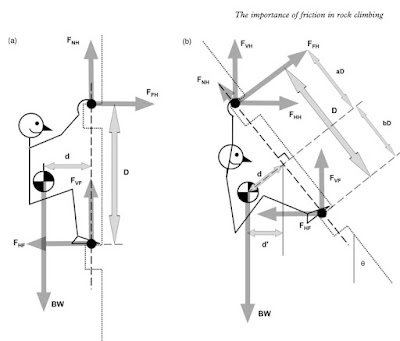
En appliquant le concept physique à l'escalade, le coefficient de friction est le ratio des forces verticales sur les forces de friction horizontale entre les surfaces. Le coefficient de friction statique est le point d'adhérence maximale possible, après quoi la main se mettra à glisser sur la  surface de la prise ou du rocher.

La première force (verticale) implique la somme de la masse du grimpeur et des forces appliquée par les mains et les pieds, tandis que la force horizontale (tangentielle) tient compte de la distance entre le centre de masse et le mur. Ces forces sont évidemment calculées en tenant compte de l'angle de la prise et du mur.

Selon la loi d'action-réaction: lorsqu'un corps exerce une force sur une surface, le corps subit une force d'égale magnitude, mais de sens opposé. Voilà pourquoi sur le diagramme, les flèches (vecteurs) de force pointent vers le haut. 


En situation d'escalade
-Tant qu'un grimpeur produit ce ratio plus petit que le coefficient de friction statique (point auquel un glissement s'observera) il maintiendra le contact avec la prise.
-lors que les pieds montent et que la distance entre les mains et les pieds diminue, une plus grande force au niveau des mains est requise pour maintenir le coefficient de friction.
-Plus la distance du centre de gravité est loin du mur, plus grande sera la force horizontale ce qui obligera le grimpeur a appliquer une plus grande force avec les mains. C'est justement pourquoi pour des prises difficile à tenir (comme des slopers), on veut ramener notre centre de gravité vers le mur.
-Si le poids du corps est distribué sur les pieds, la force de friction requise au niveau des mains sera plus petite, ce qui fera augmenter le ratio µ.

Fuss, F.K. (2012) Diagramme des forces sur un mur vertical et sur un mur incliné


Le sujet du coefficient de friction se complexifie encore d'avantage, car en plus des paramètre discutés ci-haut (position du corps, distance entre le centre de gravité et le mur, distance entre les pieds et les main), plusieurs autres facteurs vont venir le moduler.  

L'humidité de la peau, l'humidité et la température ambiante, la rugosité de la prise, l'adhérence au matériel de la prise,  l'aire de contact de la peau sur la prise, l'expérience du grimpeur et potentiellement l'utilisation de la magnésie viendront augmenter ou diminuer le coefficient de frottement.

Ceci est du au fait que la peau  des propriétés variables et la capacité de se déformer contrairement à un  matériau solide. Le coefficient de friction n'est donc pas une constante entre la prise et la peau du grimpeur.  Fuss a pu démontrer dans une étude en 2008, qu'un grimpeur élite (dans le top 20 du classement mondial) avait pu générer une valeur de 0,95 de coefficient de friction mesuré par une prise instrumentée de capteurs de force lors d'une voie en compétition. Un autre grimpeur a glissé de cette même prise ayant généré seulement 0,48 de coefficient de friction.  Les 23 grimpeurs de cette compétition avaient généré en moyenne un coefficient de friction de 0,63 sur la prise. Ceci veut donc dire qu'avec l'expérience, un grimpeur pourra produire un coefficient de friction plus grand et limiter le glissement. 

Une deuxième expérience de l'auteur avait confirmé que la répétition d'une voie améliore aussi les paramètres mécaniques, si bien qu'entre la première ascension et la 8e,  le coefficient de friction, tel que mesuré sur une réglette, avait augmenté significativement. 


Revenons au cas de la magnésie. Est-ce que celle-ci aide le grimpeur à voir une meilleure adhérence? Malheureusement pour nous, la méthodologie de plusieurs études voulant calculer le coefficient de friction ne reproduit pas la situation réelle de la grimpe. Certains protocoles mesuraient la force pour résister au glissement, alors que les sujets étaient assis et qu'un appareil tirait sur la surface pour la faire glisser.  Les forces produites par la main du grimpeur étaient bien en deça de celles d'une situation de grimpe. 

L'autre principale  critique selon moi est que plusieurs auteurs ont calculé le coefficient de friction statique maximal, mesuré au point imminent de glissement. En escalade, par contre, il n'y aucun avantage et aucune nécessité de s'approcher du point de glissement, car le grimpeur s'approcherait dangereusement d'une chute! 

D'un autre point de vue, même si on peut questionner la représentativité des études, voyons quand même ce que ces chercheurs ont trouvé, car le changement de ce coefficient de friction statique maximal pourraient quand même augmenter ou diminuer la "marge de sécurité" qu'à le grimpeur en tenant une prise. 


ESCALADE EXTÉRIEURE

Voici les résultats combinés de Li, Amca et Carre sur l'effet de l'ajout de magnésie pour différent types de roche.


grès (sandstone) : augmentation du coefficient de friction statique maximal chez 2 auteurs sur 3, pas de différence entre la magnésie en poudre vs la magnésie liquide.


calcaire (limestone) : augmentation du coefficient de friction statique maximal chez 1 auteur sur 2. 


granite:  diminution du coefficient statique maximal


ardoise (slate) diminution du coefficient statique maximal

Donc, sur le calcaire et le grès il y aurait un bénéfice d'utiliser la craie mais ce serait désavantageux sur du granite ou de l'ardoise. Pour un type de roche lisse, ajouter de la craie (une substance granuleuse) aurait l'effet d'un roulement à bille, ce qui diminuerait le coefficient de friction statique maximal. Pour une roche rugueuse, l'utilisation abondante de craie rempli ou bouche les aspérités, diminuant aussi le coefficient de friction. Dans une situation où la roche est mouillé ou lorsque les doigts sont humides ou mouillés, il n'y aurait aucun bénéfice à utiliser de la magnésie solide ou liquide, car le coefficient de friction n'est pas statistiquement différent de la situation "main nues". 


ESCALADE INTÉRIEURE

En ordre de coefficient de friction du meilleur au plus petit selon Fuss pour l'escalade sur prise artificielles.

1-Craie sur prise propre 

2-Main sèche et propre sur prise déjà poffée

3-Craie liquide sur prise propre

4-Main sèche et propre 

5-Main mouillée

6-Magnésie sur prise déjà poffée

Premier constat: L'utilisation de magnésie sur une prise neuve améliorerait significativement le coefficient de friction toutes conditions confondues. Cette différence est notable par rapport à l'utilisation de la magnésie liquide, pour une prise propre. 

Deuxième constat: sur une prise propre le coefficient de friction entre une main mouillée, sèche ou enduite de magnésie liquide ne serait pas statistiquement différent.  

Cependant, à moins que vous soyez un ouvreur ou que vous ayez un mur à la maison il est très rare de grimper sur des prises propre. Ce qui nous amène au

Troisième constat:  l'utilisation de magnésie sur une prise déjà polluée réduit significativement le coefficient de friction, par rapport à une main sèche et propre sur cette même prise. 


Bref, plus les grimpeurs essaient de bénéficient de la prise neuve avec de la craie, plus elle devient polluée au point qu'une main sèche, sans magnésie devient la solution à adopter. Est-ce qu'il y a donc un désavantage pour les grimpeurs subséquents?  Bien que le coefficient de friction entre ces deux conditions n'est pas statistiquement différent, le grimpeur qui veut utiliser une prise déjà enduite de craie devra se laver assécher ses mains pour bénéficier de la même friction, ce qui n'est pas vraiment réaliste en compétition. Le fait de brosser la prise n'élimine pas complètement la magnésie sur sa surface, donc oui il y aurait potentiellement un avantage pour les premiers grimpeurs. 

Deux autres laboratoires ont analysé l'effet de la craie lors de situation réelles de grimpe intérieure.

 La première étude analysée se concentraient sur le nombre de traction sur des prises d'entrainement. Selon Bacon, l'utilisation de magnésie aiderait à augmenter significativement le nombre de pull-ups effectués à 50% du poids du corps sur des pincettes ou des prise tendues. Les 9 grimpeurs participants ont pu faire en moyenne 3 tractions de plus  en open-hand et 5 tractions additionnelles en pinch avec les mains "poffées".  

Kilgas tant qu'a lui a calculé plusieurs paramètres lors d'un problème de bloc, précédé et suivi d'une suspension sur poutre. Il pu mesurer qu'en présence de magnésie, les 19 grimpeurs étudiés avaient été capable de se suspendre significativement plus longtemps (14 secondes additionnelles en moyenne).  Aucune autre variable mesurée par l'auteur n'a montré de différence statistique.  Ni le coefficient de friction, ni l'activation musculaire, ni les forces verticales (mains et pieds), ni l'économie de mouvement, ni le temps de grimpe ne différaient entre la condition avec magnésie ou sans magnésie.

En lumière de leur résultats, les auteurs suggèrent donc un effet psychologique relié à l'utilisation de la magnésie!  Pas besoin non plus de mettre de la magnésie si vous faites des tractions sur une barre d'acier, ceci réduirait le coefficient de friction si vos mains sont déjà propres et sèches ou même légèrement humides. Il vaut mieux assécher la barre d'acier si elle devient humide. (Carre)


ASSÈCHEMENT MAINS

Deuxièmement , est-ce que la magnésie assèche vraiment les mains et est-ce que cela aide la performance? Regardons d'abord les caractéristiques de la peau et l'impact de l'humidité.

Notre peau a des propriétés viscoélastique qui lui permettent de se déformer pour augmenter la surface de contact, bénéfique au coefficient de friction. Bourne et ses collègues dans un article de 2011 ont pu démontrer que le fait de pouvoir tenir sur des micro prises (de 2,8mm et 4,3mm) n'était pas relié à la force des doigts absolue, ni le ratio de la force sur la masse corporelle, mais bien à la dimension de la pulpe sous le doigt. Un plus grand "volume" de peau permettrait une déformation plus importante du bout du doigt, augmentant la surface de contact avec la prise. La production de force sur ses prises serait ainsi améliorée. Les auteurs concluent qu'une peau souple serait la clé pour tenir sur des minis réglettes.

D'autres auteurs (Li, Kilgas, Amca) abondent en ce sens: l'ajout d'eau sur la peau améliorerait sa flexibilité et sa capacité à se déformer, ce qui augmente la surface de contacte et la friction!  Ces chercheurs en sont venus à ces conclusions car, le fait d'humidifier la main avec une éponge mouillée n'a pas changé significativement le coefficient de friction. Bien que auteurs avancent que l'ajout d'eau améliore la friction, cet effet ne durerait que 10 à 15 minutes, jusqu'à l'évaporation de l'excédent d'eau et le retour à l'état 'normal' de la peau. 

L'inverse serait aussi vrai: une sècheresse extreme rend la peau moins souple donc réduirait la surface de contact et abaisserait coefficient de friction.  Bref, une peau extrêmement sèche ou extrêmement humide seraient reliées à une basse friction. Le mieux est d'arriver au niveau optimal d'humidité cutanée.

En escalade par contre,  le fait de maintenir une préhension pourrait bloquer le mécanisme d'évaporation d'eau au niveau de la peau et contribuer à créer une interface humide et lubrifiante. Donc, s'il y a trop d'humidité, ce film lubrifiant va venir réduire la friction. La magnésie serait donc utile pour contrer cet effet.

Cependant, selon Carré, l'application de magnésie et de craie liquide n'auraient pas d'effet sur le taux d'humidité de la peau et ne permettrait pas de l'assécher lorsque les mains sont déjà propres. Le chercheur a utilisé un instrument qui mesure l'humidité de la peau, à l'instar de ceux pour calculer le % d'eau dans le bois. Le taux d'humidité de la peau restait le même avec ou sans magnésie. Si les mains étaient humides, le fait de mettre ou non de la magnésie ne changeait pas significativement le coefficient de friction. 

Nous ne savons cependant pas l'effet de la magnésie en présence de sueur, de sébum ou de poussières ou de saletés. 

Quand est-il des conditions environnementales? Les informations sont malheureusement contradictoires. L'impact de l'humidité et de la température ambiante: le coefficient de friction de la peau doublerait entre une humidité de 30% et de 90% selon les informations rapportés par Kilgas. Quand à lui, Amca ne rapporte aucune corrélation statistique entre l'humidité, la température et le coefficient de friction pour l'étendue entre 11 et 28 C et 28 à 75% d'humidité. Il serait intéressant d'analyser la relation au delà de cette fenêtre et aussi comment la condensation sur la roche affecte la friction. Selon Carre, le grès (sandstone) est très efficace à absorber et dissiper l'humidité sans affecter le coefficient de friction, rendant l'utilisation de magnésie inutile. Nous n'avons pas d'information sur les autres types de roche.


CONCLUSION 

En lumière de toutes les informations présenté dans le présent texte, voici ce que la Clinique des grimpeurs vous suggère

1-En dehors des séances de grimpe, gardez vos mains à  un niveau idéal d'hydratation. Il n'est pas question ici de faire la promotion de produits hydratants, mais bien de vous faire évaluer l'état d'humidité de votre peau et d'en prendre soin si elle est trop sèche. Quelques auteurs ont soulevé que le pouvoir asséchant de l'alcool isopropyl contenu dans les désinfectants pour les mains réduirait le coefficient de friction entre la peau et les surfaces. Ce produit, pourrait être intéressant pour un grimpeur qui a les mains excessivement humides.

Il semblerait qu'une hydratation optimale de la peau augmentera sa plasticité, la surface de contact et le coefficient de friction en plus de diminuer les risque de blessure cutanées (craques, fissures et autres) reliés à la sécheresse. Carre rapporte que si les produits hydratants sont déjà absorbés cela pourrait même aider à réduire le niveau de sudation des mains...

2- Lavez-vous les mains avec de l'eau et du savon et asséchez-les à l'air libre avant une séance d'escalade. Cette opération élimine les dépôts de substances graisseuses et de saletés et semblerait produire les conditions idéales pour la meilleure friction possible.

3- Ne mettez-pas de craie immédiatement en gymnase. Si les prises sont déjà "contaminées" à la magnésie,  une main propre et sèche est la meilleure solution pour une friction maximale.

4- Avant de plonger dans votre sac de craie si vous ne réussisez pas un mouvement, essayer de travailler votre beta pour trouver une meilleure position corporelle vous permettant de maintenir le contact avec la prise, par exemple en amenant votre centre de mass plus près du mur. Nous avons également vu que le coefficient de friction se module enfonction de la distance entre les pieds et les mains et selon la proportion de la force verticale entre les mains et les pieds.  La répétition du mouvement aide aussi à augmenter le coefficient de friction.

5. Utilisez une serviette propre en textile qui absorbe l'humidité pour assécher vos mains. Une serviette en cotton pourrait être une idée à explorer. Peut-être allez-vous trouver d'autres alternatives pour sécher vos mains? on a vu des grimpeurs amener de petits ventilateurs portatifs, par exemple. 

6. Travailler votre résilience mentale en vous exposant à une variété de prises à la fois intérieures et extérieures pour construire un vaste répertoire d'exposition au propriétés des différentes prises et type de roches. Votre perception de l'adhérence d'une surface va moduler la force que vous aller y appliquer et affecter le ratio entre les forces appliqués et la force de frottement (coefficient de friction). Vos aptitudes perceptivo-cognitives dépasseront alors l'utilité de la magnésie. vous pourrez répondre rapidement aux propriétés d'une nouvelle surface. 

* petite note pour les ouvreurs: dans cette optique, il pourrait être intéressant d'améliorer l'expérience d'entraînement et de proposer des surfaces non conventionnelles, si elles sont sécuritaires. Les grimpeurs gagneraient en versatilité et devriendraient plus apter à répondre rapidement aux propriétés d'une nouvelle suface. Nous avons déjà vu des rondelles de hockey en caoutchouc (étonnamment adhérentes!) comme prises sur un mur.

7. Si on doit vraiment utiliser de la magnésie : éliminer au maximum l'exécent, ne l'utiliser que sur des grimpes difficiles (en avez-vous vraiment besoin lors de votre réchauffement?), ne l'utiliser que lorsqu'on entraine l'endurance sur hangboard ou les tractions sur des prises.  

8- Abolissez la magnésie et soyez confortable avec ce niveau de friction. La Clinique des grimpeurs a déjà exploré les risques pour la santé de la poussière de magnésie. Nous explorerons les aspects environnementaux dans un autre billet. 


Références

Amca, A.M. et al (2012) The effect of chalk on the finger-hold friction coefficient in rock climbing, Sport Biomechanics, 11(4), p. 473-479.

Bacon, N.T. et al. (2018) Effect of Magnesium Carbonate use on repeated open-handed and pinch grip weight assisted pull-ups,  International Journal of Exercise Science, 11(4), p. 479-492.

Carre, M.J. et al (2012) An assessment of the performance of grop enhancing agents used in sports applications. Proceesings of the Institution of mechanical Engineers, Journal of Engineering Tribology, 226(J7), p.616-625.

Fuss, F.K., Niegl, G. & Tan, A.M. (2004) Friction between hand and different surfaces under different conditions and its implication for sport climbing, The Engineering of Sport 5 (2), p. 1-6.

Fuss, F.K. & Niegl, G. (2008) Instrumented Climbing Holds and Performance Analysis in Sport Climbing, Sports Technology, 1(6), p.301-313.

Fuss, F.K. & Niegl, G. (2012) The importance of friction between hand and hold in rock climbing. Sports Technology, 5 (3-4), p. 90-99.

Fuss, F.K. et al. (2020) Climbers' perception of hold surface properties: roughness versus slip resistance. Frontiers in Psychology, 11, (252) p.1-13.

Kilgas, M.A. (2016) The Effect of Magnesium carbonate (chalk) on geometric entropy, force and electromyography during rock climbing, JOurnal of Applied Biomechanics, 32(6), p.553-557.

Li, F.-X., Margetts, S. & Fowler, I. (2001) Use of chalk in rock climbing: sine qua non or myth? Journal of Sports Sciences, 19, p.427-432.


Allo Prof: La force de frottement, en ligne  https://www.alloprof.qc.ca/fr/eleves/bv/physique/la-force-de-frottement-p1018

Allo Prof: La troisième loi de Newton, en ligne https://www.alloprof.qc.ca/fr/eleves/bv/physique/la-troisieme-loi-de-newton-p1090


dimanche 4 octobre 2020

Route Setting Injuries Survey: Descriptive Results


During the months of May through July 2020, The Climber's Clinic asked route setters to complete a web-based survey regarding work and injury profile. It was both accessible in French and in English. The link to the survey was posted on many route setting and climbing facebook groups and most Canadian indoor gyms were reached via their facebook page or by e-mail. The english  version is still accessible here: 

https://docs.google.com/forms/d/e/1FAIpQLSf-1dz3rsy_PEwoETU0uGugb24oJdwxESYtc4dmxZx8ptC2aQ/viewform?usp=sf_link

We will keep updating the numbers from this blog entry should there be more survey entries.

162 setters answered questions about their work (duration of a setting day, frequency per week, number of breaks, % of forerunning vs other tasks, experience in years) as well as work acccidents and chronic injuries (body area injured, nature of the injury). Since this survey has descriptive and exploratory purposes, we did not calculate correlations or used inferential statistics methods. Microsoft Excel was used for descritive statistics calculations and graphs.

We obtained 81 responses from Canada, spread out between 6 provinces, 47 responses from the United States of America spread out between 17 states. We finally had 27 international responses, as seen on the map below. (We were unable to localize the remaining data,  since it was left blank).


78,6% of responders were males, 18,9% were females ( 2,5% prefered not to say). With regards to age group, the mean age was 29 years old, with the median of the distribution being 27,5 years old. As seen in the graph below, the majority of setters were between 22 and 33 years old.


As for the number of years of experience as a setters, the participants had in average 4 years of experience, with the median being 3.5 years. Those numbers might be underestimating the real data, since the last category (9+ years, which constitute 17,1% of setters) was an opened category.


In average,  route setters are employed in average 2.5 days per week, with the median being 2 days per week. They work for 7,3 hours per day in average (median 8h). The full distributions can be seen below. 


In addition, route setters were asked what percentage of their day is devoted to forerunning as opposed to other route setting tasks. In average, they responded that they spent 38% ot their time forerunning (with a median of 40%). As seen below, only 11,4% of  setters spend more time forerunning compared to doing other route setting tasks. 


With regards to the number of breaks during a regular working day, it varied between 0 and 3, with the mean being 1.3 breaks per day and the median being 1 break per day. Concerning the duration of those breaks, it was in average 36 minutes with the median being 30 minutes.


Next, reoute setters were questionned about work-relateds injuies. 78,5% of route setters reported they had sustained an injury at work, while 18,9% did not. The remaining 
were not sure if it was a result of work. 

Concerning the outcome of their injuries : 31% of setters had to take time off work as a result of a work injury, while 37% had to adapt or modify the way they work and their tasks  because of their injury.

The survey highlighted different types of injuries : accidental and chronic. 61% of route setters have sustained a accidental injury (defined as a sudden event resulting in an injury to the worker.)

The graph below details which body areas where hurt during accidental injuries. 


Here were the main causes of the accidental injuries in route setters as reported in the
 survey: 

Dropped tool or hold hitting body part resulting in cuts, bruises.
Metal, wood, dust or other debris in the eyes.
Body part banged against a hold or wall resulting in contusions and ecchymosis
Fall from a ladder causing ankle sprain, dislocation or fracture, neck whiplash 
or concussion.
Penetrating object (drill bit, screw) puncturing fingers or feet.
Heavy or improper lifting and long period in the harness causing low back strain.
Strenuous moves while forerunning causing ligament and joint capsular sprains
 to fingers, wrists, shoulders, knees and lower back. 

The second type of injury  aloso known as "work-related occupational disorders", are chronic or overuse conditions that develop gradually as a consequence of stressful work tasks repeated over time. The distribution below shows which body areas were mostly afffected from chronic conditions due to route setting. 


Concerning the nature of the condition, here is what route setters reported: 
  • Shoulder:  bursitis, capsulitis, tendonitis, tendinopathy 
  • Elbow:  epicondilitis, epicondalgia 
  • Wrist : instability, de Quervain tenosynovitis 
  • Finger:  pulley injury, finger flexors tenosynovitis 
  • Neck: strain, cervicalgia 
  • Lower Back:  strain, lombalgia 
  • Nerve Impingement syndrome: carpal tunnel syndrome, thoracic outlet syndrome
Lastly, when asked what could have helped prevent their injuries, here is what route setters responded:


Appropriate tools are described as protective eyewear, hand tools, ladder, carts or lifts. Other preventative measures were described as better and more specific warm-up, more time to set (with a very short setting time, setters felt rushed in their tasks), less frequency of setting per week, the implementation of a security protocol and a better training periodization between climbing, training and setting. 

To sum, the results of the survey first showed that a vast majority (78,5%) of route setters get injured at work. The first component of prevention measures would be to look at safety and security practices. Each center should respect health and safety legislations effective in their country and have an inhouse protocol to help reduce accidental injuries. 

Second, looking at risk factors for work-related musculosqueletal disorders is more complex, but seems mandatory since almost 3 out of 4 route setters suffers from such chronic conditions. Data from other manual labour professions and climbing should be looked at to implement prevention measures. 

Of course, this exploratory survey leaves many more questions. It is not known at the moment if there is a correlation between risk of accidental injuries and distribution of tasks (forerunning vs routesetting). It is also not known if there is a correlation between overuse injuries and the frequency of route setting in a week, duration of working days or number of breaks. Also does years of experience influence the risk of accidental and chronic injuries? Something else to explore would be the number of climbing sessions outside of working days and the impact on the risk of injuries. 

Please let us know yours thoughts on the results of this survey!


Evelyne Lajoie, MSc PT for The Climber's Clinic/La Clinique des grimpeurs. 

Oct 2020.


jeudi 26 mars 2020

Chalk Dust in Climbing Gyms: Guide to Better Air Quality


In a previous article, The Climbers' Clinic exposed potential health risks linked with climbing chalk dust in indoor climbing gyms. It was shown that magnesium carbonate dust concentrations largely surpass all environmental and governmental ambiant air standards.

Due to their sub 10 micron size, magnesia dust particles are small enough to deposit in the lungs gas exchange region.  Symptoms such decreased expiratory lung function was documented and industrial product safety notice report respiratory tract irritation, coughing or shortnerss of breath as a result of exposure. (1)(2) Moreover, a portion of magnesium carbonate particules are smaller than 2.5 microns, to which no safe level exist; meaning that health adverse effects can occur at any exposure level (3). This is a concern with more kids participating in indoor rock climbing as well a people from diverse health backgrounds. According to the EPA (United States Environmental Protection Agency) indoor particulate matter concentration would be expected to be the same as, or lower than, outdoor levels. (4)

The Climbers' Clinic has prepared a list of healthy behaviours for climbers and strategies for gym owners in order to improve indoor air quality in climbing facilities.

Individual responsibilities


What strategies were proven beneficial?

Weinbruch et al (2012) tested several magnesia dust reduction strategies: ban climbing chalk use,  liquid chalk only, block chalk only, powdered chalk, sieved chalk and chalk balls only. According to their results, liquid chalk use and no chalk at were both very effective in keeping dust levels low. A reduction of 70% of dust concentration was measured with either one of these conditions. It was even more effective than turning the ventilation system on! (5)

Adapted from Weinbruch et al. (2012) Dust concentration per climber were calculated in order to compare different gyms. We added the data from the ventilation system. 

Furthermore, climbing gym rules limiting the use of a certain type of climbing chalk over another (powdered or sieved vs ball) are not supported scientifically. Block chalk, powdered chalk, sieved chalk and chalk ball ALL yield similar level of magnesia dust concentration in the air. 

Now, what can gym owners do to improve air quality in their facilities? Upgrading the ventilation system and reduce climbing chalk use are the two best measures, along with dilligent cleaning procedures.

Gym owners responsibilities


Again, what is the efficacy of such measures?

Castro et al (2015) were able to determine that cleaning operations at the end of the day (before closure) reduced  the concentration of magnesia at about 90% of their level during the day. (5) PM 2.5 and PM 10 continue to decrease 4h after cleaning procedures. 

Fine particules however, take up to 14 hours to deposit. Castro et al (2015) and Alves et al (2015) both were able to quantify that resuspension of dust particles (previously deposited) is a major source of air pollution.(5)(6).Thus, cleaning activities prior to facilities opening can help reduce a significant portion of magnesia dust by preventing its resuspension. The authors suggest the use of powerful vacuum cleaners with HEPA filters.

In addition, choosing nylon or vinyl bouldering matress is preferable over carpet-like surfaces.  The authors showed that foam, carpet or other porous surfaces trap dust and are harder to clean throrougly. When a climbers falls on a dusty "carpet finish" bouldering mat, the dust resuspension phenomenon is quite visible. 

What about air filtration devices? While two previous authours sugested the use of adequate air filtration systems, Almand-Hunter et al (2013) tested the efficacy of various air filtering strategies. (8) 
Their team measured the effect of compact air filters and electrostatic precipitating air cleaners. Their preliminary results show that the buiding ventilation system is the only effective way of reducing magnesia dust concentration in the gym. There was no impact on air quality in adding air filters in the reception area, the gym office or adding 5 electrostatic precipitating air cleaners throughout the gym climbing area. In comparison, running the air conditionning ventilation system reduced magnesia dust concentration to 70% of baseline levels. The ventilation system had a rate of 7.1 total gym air volume renewal per hour. 

Weibruch et al (2012) evaluated that a poweful ventilation system can reduce 40 to 60% of dust concentration compared to baseline values (see graph above). They tested a ventilation system that had a air exchange rate of 8100 m³ per hour: the gym's total air volume was renewed 1.5 times in an hour. The other studied ventilation systems, which  air exchange rate were 2000 or 4000 m³ per hour,  failed to reduce dust concentration in their respective gyms. 

Due to building constraints, climbing gyms may still opt for filtering systems, but owners must ensure that they are designed for particles in the 1 micron size. Moreover, filters might need to be replaced or cleaned more often thant the manufacturer's indication. For instance, some devices were designed for gymnastic facilities, where dust concentration is never as elevated as in climbing gyms. Maximal magnesia dust concentration in gymnastic halls can reach 900µg per m³ but can get as high as 4000µg par m³ in climbing gyms! (6)(7)(9) As a matter of fact, dust concentrations in climbing gyms are similar as the ones measured in the textile, mining or chemical industries! (9) Fortunately magnesium carbonate has a low loxicity... 

In conclusion, there is only two effective strategies to keep air quality in climbing gyms. The first one is that each climber limit their climbing chalk use, use liquid chalk or learn to climb without chalk althogether. The second effective measure is for gym owners to invest in a powerful ventilation system with sufficient air exchange rate in relationship to their gym air volume. Meticulous daily cleaning also help prevent resuspension of dust particles.

According to Health Canada: "the most effective way to reduce indoor air pollution is to remove or reduce the source of contamination." (10)  Air filters can help to reduce the amount of pollutants indoors but is rarely effecient as a stand alone measure. 

Lastly, before investing in costly air filtration systems, The Climber's Clinic would recommended to get an air quality analysis by independant firms. Many compagnies perform tests that measure precicely the level of fine particles and their composition. Long term solutions can then be implemented according to the gym's specific needs. 

Special thanks to Marie-Pier Breault from MDDLECC and Patrick Hughes from CCHST for their precious informations, Thibault Stimpling for scientific articles and  Milan Brlek for finding typos.


References

(1)Moshammer (2016) Lung function and dust in climbing halls. Rev Environ Health.31(4):401-407

(2) https://www.psh.ca/MSDS/Magnesium%20Carbonate%20-%20A&K%20Petrochem.htm
Hazard/Safety Labels for Chemical Containers

(3) Health Canada (2012) Guidance for fine particulate matter (PM2.5) in residential indoor air. https://www.canada.ca/en/health-canada/services/publications/healthy-living/guidance-fine-particulate-matter-pm2-5-residential-indoor-air.html

(4) EPA (n.a) Indoor Particulate Matter https://www.epa.gov/indoor-air-quality-iaq/indoor-particulate-matter#Levels_in_Homes

(5) Weinbruch, S. et al. (2012) Reducing Dust exposure in indoor climbing halls. Journal of Environmental Monitoring. 14, 2114-2120.

(6)Castro, A. et al. (2015) Indoor aerosol size distributions in a gymnasium. Science of the total environment 524-525, 178-186.

(7) Alves C. et al (2014) Particulate matter in the indoor and outdoor air of a gymnasium and a fronton. Environ Sci Pollut Res 21 (21) 12390-402.

(8)Almand-Hunter, B.B. (2013) Dust exposure in indoor climbing facilities, Department of Mechanical Engineering, University of Colorado, Boulder, CO

(9)Weinbruch S. et al (2008) Dust exposure in indoor climbing gyms. Journal of Environmental Monitoring. 10, 648-654.

(10)Health Canada (2018) Improve indoor air quality. https://www.canada.ca/en/health-canada/services/air-quality/improve-indoor-air-quality.html

mercredi 25 mars 2020

Everything you always wanted to know about chalk but were afraid to ask


Photo par frank mckenna sur Unsplash

In the mid-fifties, climbing chalk was brought to the climbing world by John Gill, a former gymnast. (1) Nowadays, more than thirty local or international compagnies are selling climbing chalk, wether liquid or solid, in chunk or powder version.(2) Magnesium carbonate is part of a climber's attire and considered as an essential item to any vertical endeavour. On a buzy night at the gym or during a climbing competition, its white dust cloud becomes clearly visible. Climbers and gym employees are inevitably exposed to magnesium carbonate dust particles. Looking at the scientific litterature, exposition to elevated concentration of magnesia dust could be linked with symptoms such as headaches, coughing, respiratory tract or occular irritation.(3) However, no quantitative data is available.

The Climbers' Clinic will try to answer a burning yet taboo question: are there any health related risks linked to an exposition to magnesium carbonate? We will look at the substance toxicity, the size of its particles, the concentrations reached in climbing gyms and how they compared to ambiant and occupational air standards.


Magnesium Carbonate Toxicity


Climbing chalk, magnesia alba or magnesium carbonate (MgCO³) is a salt derived from magnesite, a mineral. (4) Its drying properties are well know and when climbers use it on their hands, solid particles are relased in the ambiant air. Is the substance toxic? According to safety labels used in the chemical industry, magnesium carbonate is graded 1 (out of a 4 points scale) for health hazards. Exposure can cause irritation to the respiratory tract with only minor residual injury. (5)(6)(7)

Magnesium carbonate Material Safety Data Sheet, Spectrum Chemicals 2012. 
Technically speaking, its is hydrated magnesium carbonate hydroxide that is found in suspension in the air. Similar molecule, with a thin water film around it. 

Despite a low toxicity, every industrial safety notice states that magnesisum carbonate can cause respiratory tract irritation, coughing and breathing difficulties. Direct contact can also cause irritation or redness. Uppon inhalation, moving to fresh air is advised and rinsing the hands or eyes for 15 minutes is recommended after any contact with the substance. Definitely the industry has much higher safety precautions than the climbing world! Still, even if it is safe for our use, deposition of solid particules of magnesia can produce a mechanical irritation of the muquous layer in the respiratory tract.(8) 

Size of magnesia particles


In order to understand how dust particles can affect our respiratory system, we have to look at their size and the depth of their penetration in the breathing apparatus (see image below). Dust particles are measured in micrometers or microns (µm). As a comparison, a human hair has a diameter of 50 microns but ultrafine particles measure less than 1 micron. (35)
https://www.ccohs.ca/oshanswers/chemicals/how_do.html

Looking at particle size, total dust can be divided in three different fractions, summarized in the table below. (9)(11)


The 10 microns size was established by international agencies as the boudary for respirable particles, since particles this diameter and lower can settle in the lungs. (12) Three measures monitor their level: PM10, PM2.5 and PM1. They are the Particulate Matter Concentration (in mg per m³ or µg per m³) up to the number size in microns. For instance PM 2.5 refer to the concentration of particles up to 2.5 microns.

Now, let's look at the size of airborne particles found in climbing gyms. (3)(8) According to the only two studies published on the topic, it ranges from 0.7 to 10 microns, as illustrated from the graph below. In addition, studies that analyzed the indoor air of gymnastics facilities (that also use magnesia) concluded that 90% of dust particle diameter size was higher than 1 micron and averaged 2.6 µm. Moreover, utilisation of magnesia was increasing the concentration of particles between 0.4 to 10 microns compared to situations where it was not used. (13)(14)


Magnesium carbonate dust particles are thus small enough to reach as deep as the alveoli in the respiratory system. When measuring fractions of magnesia dust, Castro et al (2015) and Alves et al (2016) found that


  • inhalable fraction was 80% of total dust
  • thoracic fraction was 54% of total dust
  • respirable fraction was 10-14% of total dust 

Given those numbers, are there any "safe" concentrations to magnesium carbonate particles? 

Occupational tresholds and ambiant air standards.


Many governmental body have establised treshold levels for dust exposure. The Permissible Exposure Limit or the Treshold Limit Value respectively represents "acceptable" dust particule exposition in absolute or measured in time and the level at which a worker can be exposed daily wihtout longterm adverse effects. (15)(16) 

The OSHA (Occupational Safety and Health Administration), the ACGIH (American Conference of Governmental Industrial Hygienists), the NIOSH (National Institute for Occupational Safety and Health) have all estalished dust exposition standards in the workplace. 

The CCOHS (Canadian Center for Occupational Health and Safety) and most provincial health and safety agency use the american standards for their own occupational exposure limits. This includes WorkSafe BC, Alberta Occupational Health and Safety, the CNESST (Commission des normes de l'équité de la santé et de la sécurité au travail, in Quebec) and Ontario Health & Safety. We did not checked the other provincial and territorial agencies. 
The current standards are summarized below: (5)(17)(18)(19)(20)(21)


However, most of the previous values were developped for industrial work places where hazardous materials pose potiential health risks. Such occupational exposure limits may not be applicable to indoor air quality in schools, gymnasium or offices.(22)  Yet, in North America, no norms exist for indoor air quality, although standards do exist for ventilation and specific contaminants such as mold or carbon monoxide.(23) No standard for dust or magnesia dust was found. Thus, the only other guidelines we can refer to for climbing gyms are ambiant (or outdoor) air quality standards.


The WHO (World Health Organization), the EPA (Environmental Protection Agency in the USA), the  CCME (Canadian Counsil of Ministers of the Environment)  and the various provincial agencies have established the following standards for ambiant air, summarized in the table below. (24)(25)(26)(27()(28)(29)(30)(31) You will note concentrations are now expressed in µg: 1000µg equals 1mg.


*Québec: Ministère du developpement durable, de l’environnement et de la lutte contre les changements climatiques  **OMECC: Ontario Ministry of the Environment and Climate Change

Magnesium Carbonate Dust Concentrations in Climbing Gyms


Amongst the scientific litterature, only 4 articles measured dust concentration in indoor climbing gyms.(3)(32)(33)(8) Here are their results, summarized in the table below.


According to the previous results, we can state that even if magnesia dust concentrations are lower than occupational norms, they largely surpass ambiant air quality tresholds for both PM10 and PM 2.5. Even the sampling done during low occupancy times (minimum colomn) are above the recommended level. Are there any health effects of such conditions?


Respiratory system health effects


According to Moshammer et al. it is the peak exposure that will determine respiratory tract effects more than the cumulative burden on the pulmonary system.(8) In their study, the authors examined short term effect of a single exposition to climbing chalk. Higher was the exposure (in either the duration of the climbing session or the level of magnesia dust concentration), greater was the decrease in pulmonary expiratory capacity. A two-fold physiological reaction was observed. Firstival, high magnesia dust concentration resulted in a reflex contraction of smooth muscles around the bronchioles. This increases the resistance of larger airways. The body then secretes nitric oxide to relax those muscles. Following this chemical stress, the second inflammatory reaction is triggered by the body's immune system, as observed in the epithelium muquous layer. This reaction can be observed up to 24 hours after the initial exposition and affects smaller diameter airways.


Inflammatory reaction in a bronchiole
https://canadiem.org/approach-asthma-ed/
Although the authors' results were not statistically significant, a reduction in pulmonary function was measured directly after a climbing session. This effect was greater in people already presenting a respiratory fragility. Moreover, after 3 hours of participation in a climbing competition, a greater reduction was observed in competitors having started earlier or amongst young climbers. The 24h reaction was observed in people already presenting an hyperreactivity of the pulmonary system. 

We still don't know if repeated exposure has repercussion on a person's health and if those aforementionned effects are reversible. A larger study is necessary.

In sum:


  • Magnesium carbonate has a low toxicity
  • Use of climbing chalk mainly produces dust particles higher than 1 micron and up to 10 microns. It is not a significant source of ultrafine particles
  • Health hazards depends on the size of particles and where they deposit along the repiratory system. (9) (10) 
  • A great majority of of airborne magnesia particles is intercepted by the nose, mouth, trachea, bronchi and bronchioles. However, 10-14% of particles are small enough to deposit in the alveoli. 
  • Even if climbing gym dust particle concentrations are lower than occupational norms, they are always above ambiant air standards for both PM 10 and PM 2.5
  • People with hyperreactive airways are more susceptible to be affected by poor air quality. Climbers with respiratory conditions should follow their Doctor's recommendations if their symptoms were to be exacerbated following an indoor climbing session.

Considering the growing number of kids starting indoor rock climbing and according to Health Canada: concentrations of PM 2.5 should be maintained to a minimum, since their is no safe treshold below which no health effect are observed. (34) The WHO also states that we should strive to atteint the lowest concentrations possible, taking into account local constraints and public health priorities. (24)The Climber's Clinic is preparing another article on how to improve air quality in climbing gyms. Stay tuned!


Special thanks to Marie-Pier Breault from MDDLECC and Patrick Hughes from CCHST for their precious informations, Thibault Stimpling for scientific articles and  Milan Brlek for finding typos.


References

(1) John Gill https://en.wikipedia.org/wiki/John_Gill_(climber)

(2) A search performed in November 2019 (on  epictv, amazon, verticall, Mec, Lacordée, Au vieux Campeur, Bachlii sport, REI, EMS, Climb On) identified  the following brands of chalk sold for climbing purposes: 8Bplus, 8C+, Beal, Black Diamond, Bleausard, Bison Design, Camp, Carbon Grip, Chalk Carter, Chalk Factory, DMM, Easy Grip, EB, Edelrid, Fixe, Flashed, Friction Labs, I'bbz, Joshua Tree, MadRock, Mammut, Massif, Matawi, Metolius, Midas, Myélore, Ocun, Petzl, Primo, Psychi, Rock Technologie, Roze, Salty Lance, Sattva, Simons, Snap, So Ill, Stubai, Tembo, Trango, Wild Country and Yama Tech Climbing.

(3) Weinbruch S. et al (2008) Dust exposure in indoor climbing gyms. Journal of Environmental Monitoring. 10, 648-654.

(4)Magnesium Carbonate   https://en.wikipedia.org/wiki/Magnesium_carbonate

(5) Environmental Health & Safety(2004) Magnesium Carbonate Hazard/Safety Labels for Chemical Containers  www.psh.ca/MSDS/Magnesium%20Carbonate%20-%20A&K%20Petrochem.htm

(6) Spectrum Chemicals (2012) Magnesium Carbonate Hydroxide pentahydrate Material Safety Data Sheet https://www.spectrumchemical.com/MSDS/M0057.pdf

(7) Fisher Sci (2014) Magnesium Carbonate Material Saftery Data Sheet, https://beta-static.fishersci.com/content/dam/fishersci/en_US/documents/programs/education/regulatory-documents/sds/chemicals/chemicals-m/S25400.pdf

(8)Moshammer (2016) Lung function and dust in climbing halls. Rev Environ Health.31(4):401-407.

(9) World Health Organization (1999) Hazard Prevention and Control in the Work Environment: Airborne Dust. https://www.who.int/occupational_health/publications/en/oehairbornedust.pdf

(10) Particulates https://en.wikipedia.org/wiki/Particulates

(11) Canadian Center for Occupational Health (2018) How to particulates enter the respiratory system?  https://www.ccohs.ca/oshanswers/chemicals/how_do.html

(12) Particulate Matter Basis (n.a) Environmental Protection Agency,  https://www.epa.gov/pm-pollution/particulate-matter-pm-basics

(13) Castro, A. et al. (2015) Indoor aerosol size distributions in a gymnasium. Science of the total environment 524-525, 178-186.

(14) Alves C. et al (2014) Particulate matter in the indoor and outdoor air of a gymnasium and a fronton. Environ Sci Pollut Res 21 (21) 12390-402.

(15)Treshold limit value (n.a) https://en.wikipedia.org/wiki/Threshold_limit_value

(16) Permissible exposure value (n.a.) https://en.wikipedia.org/wiki/Permissible_exposure_limit

(17) National Institute for Occupational Safety and Health (2019) Pocket Guide to Chemical Hazards, Magnesite, https://www.cdc.gov/niosh/npg/npgd0373.html

(18) CCOHS (2017) Occupational Hygiene - Occupational Exposure imits
https://www.ccohs.ca/oshanswers/hsprograms/occ_hygiene/occ_exposure_limits.html

(19)Québec (2019) Règlement sur la santé et la sécurité du travail, Loi sur la santé et la sécurité du travail http://legisquebec.gouv.qc.ca/fr/pdf/cr/S-2.1,%20R.%2013.pdf

(20) https://www.worksafebc.com/en/law-policy/occupational-health-safety/searchable-ohs-regulation/ohs-guidelines/guidelines-part-05

(21) Ontario (2010) Occupational Health and Safety Act, Control of exposure to biological or chemical agents  https://www.ontario.ca/laws/regulation/r10419

(22) CCOHS (2020) Indoor Air Quality https://www.ccohs.ca/oshanswers/chemicals/iaq_intro.html

(23)Occupational Safety and Health Administration (n.a) Indoor Air quality
 https://www.osha.gov/SLTC/indoorairquality/index.html

(24) World Health Organization (2005) WHO Air quality guidelines for particulate matter, ozone, nitrogen dioxide and sulfur dioxide Global update 2005 Summary of risk assessment.
https://apps.who.int/iris/bitstream/handle/10665/69477/WHO_SDE_PHE_OEH_06.02_eng.pdf?sequence=1&isAllowed=y

(25)United States Environmental Protection Agency(2014) Typical Indoor Air Pollutants https://www.epa.gov/sites/production/files/2014-08/documents/refguide_appendix_e.pdf

(26) United States Environmental Protection Agency(2016) Integrated Review Plan for the National
Ambient Air Quality Standards for Particulate Matter.
https://www3.epa.gov/ttn/naaqs/standards/pm/data/201612-final-integrated-review-plan.pdf

(27)CCME (2015) Canadian Ambient Air Quality Standards (CAAQS) for Fine Particulate Matter (PM2.5) and ozone
 https://www.ccme.ca/files/current_priorities/aqms_elements/caaqs_and_azmf.pdf    et
http://airquality-qualitedelair.ccme.ca/

(28) Ministère du developpement durable, de l’environnement et de la lutte contre les changements climatiques (2016) Normes et critères québécois de qualité de l'atmosphère Version 6
http://www.environnement.gouv.qc.ca/air/criteres/index.htm

(29) Carex Canada (n.a) Outdoor Air Pollution Profile
https://www.carexcanada.ca/profile/outdoor_air_pollution/

(30) BC Air Quality Objectives & Standards (2020)
https://www2.gov.bc.ca/gov/content/environment/air-land-water/air/air-quality-management/regulatory-framework/objectives-standards

(31) Alberta Government (2019)Alberta ambient air quality objectives and guidelines summary https://open.alberta.ca/publications/9781460134856

(32)Weinbruch, S. et al. (2012) Reducing Dust exposure in indoor climbing halls. Journal of Environmental Monitoring. 14, 2114-2120.

(33)Almand-Hunter, B.B. (2013) Dust exposure in indoor climbing facilities, Department of Mechanical Engineering, University of Colorado, Boulder, CO

(34) Health Canada (2012) Guidance for fine particulate matter (PM2.5) in residential indoor air   https://www.canada.ca/en/health-canada/services/publications/healthy-living/guidance-fine-particulate-matter-pm2-5-residential-indoor-air.html

(35) Micrometer https://en.wikipedia.org/wiki/Micrometre